JavaScript is not required: every approved resource is listed below with its prompts, activity, and links.
For parents first
Child Mind Institute · How to Tell Your Child About Their Autism Diagnosis
A practical parent guide about how to approach the conversation, including why not to delay indefinitely, how to start from the child’s own experience, how to focus on strengths, and how to respond if the child has a negative reaction.
Why it works: Parents can read this before choosing a book or video. It helps avoid turning the conversation into either a scary announcement or a vague euphemism.
Parent talking prompts
- What does my child already know about how their brain and body work?
- Which strengths should I name first?
- What support words will feel concrete for my child?
Activity idea: Read before you start
Read the guide once before the first child conversation. Then choose one book or video that matches what your child already notices about themselves.
- Start from your child’s experience
- Name strengths and supports
- Keep the first talk short
- Plan how you will answer hard questions
Read the guide
ASAN · Start Here: A Guide for Parents of Autistic Kids
Created by autistic and disability advocacy organizations, this guide covers what autism is, what parents can do next, self-advocacy, communication, presuming competence, and what good services look like.
Why it works: A strong parent background resource for neurodiversity-affirming language that avoids deficit-only framing.
Parent talking prompts
- What does presuming competence look like in our family?
- What supports help our child grow into a happy, self-determined autistic adult?
- Which services match our child’s real needs?
Activity idea: Underline your family values
As you read, underline three ideas you want to keep using at home. Post them somewhere parents can see before school mornings or hard conversations.
- Presume competence
- Support self-advocacy
- Name strengths and needs together
- Look for affirming services
Read Start Here
ASAN · Welcome to the Autistic Community
Written by autistic people for newly diagnosed autistic adolescents and adults. It is not meant for a 5–7-year-old to read alone, but it helps parents understand autistic identity and community from autistic voices.
Why it works: Use as parent background, not as the child-facing conversation.
Parent talking prompts
- What do I want my child to eventually understand about autistic community?
- Which ideas help me talk about autism without shame?
Activity idea: Parent-only reading
Read a short section yourself. Then translate one idea into child-friendly language for a later conversation.
- Autism is part of human diversity
- Support can change over time
- Autistic people are not all the same
Read Welcome
Books & workbooks
A Friend for Henry · Jenn Bailey
Henry, an autistic child, wants a friend and learns that friendship may not always happen in the way he expects. The book explores connection, personal space, and the idea that friends do not have to communicate or play in exactly the same way.
Parent talking prompts
- Henry wanted a friend, but he needed friendship to feel comfortable.
- What made friendship hard for Henry?
- What did Henry need other kids to understand?
- What are different ways people show they want to play?
- What can you do if a friend says no, needs space, or wants to play differently?
Activity idea: Friendship menu
Make a friendship menu with choices a child could offer a friend, then practice with dolls, stuffed animals, or action figures.
- Play together
- Play side by side
- Take turns
- Watch first
- Use quiet voices
- Give space
- Ask, “What do you want to play?”
- Ask, “Do you want help or space?”
Being a friend does not mean making someone play your way. A good friend notices what helps the other person feel comfortable.
BookRead-aloud video
My Brother Charlie · Holly Robinson Peete, Ryan Elizabeth Peete & Denene Millner
Narrated by a girl about her twin brother Charlie, who is autistic. Helpful for siblings because it shows both love and challenges, and reminds readers that every person deserves to feel understood, included, and loved. A Spanish edition, Mi hermano Charlie, is also available.
Parent talking prompts
- What are some things Charlie is good at?
- What are some things that are hard for Charlie?
- How does Charlie communicate?
- Can you love someone and still feel frustrated sometimes?
- What are ways siblings can help, and what are things adults should help with?
Activity idea: Strengths and supports
Draw two columns. Children can draw instead of write.
- Things I’m good at
- Things that help me
- Things my sibling or friend is good at
- Things that help them
Everyone has strengths, and everyone needs support. Autism is one part of Charlie, but it is not the only thing about him.
BookRead-along video
All My Stripes · Shaina Rudolph & Danielle Royer
Zane, a zebra who is autistic, feels worried about being different. His mother helps him understand that autism is one of his “stripes,” but not his only stripe. A natural way to say autism is one part of you, and you have many parts.
Why it works: One of the more directly useful books for a first autism conversation because it names autism while protecting the child from feeling reduced to a diagnosis.
Parent talking prompts
- Zane is autistic. You are autistic too.
- Autism is one of Zane’s stripes. What are some of your stripes?
- What are some things your brain is really good at?
- What are some things that feel hard or uncomfortable?
- What helps you when things are hard?
Activity idea: My many stripes
Give the child a zebra, rainbow, shield, star, or heart outline. Add stripes for different parts of the child.
- I like animals
- I need quiet sometimes
- I am silly
- I am learning to be brave
- I love music
- I am a good builder
- I get frustrated when plans change
- I am kind
A diagnosis can be one part of someone, but it is never the whole person. People are made of many stripes.
BookRead-aloud video
A Day With No Words · Tiffany Hammond
Follows an autistic child who communicates without spoken words and uses a tablet. Especially useful if the child uses AAC, has limited or unreliable speech, or has peers who communicate differently.
Why it works: Presents communication differences as valid, meaningful, and worthy of respect.
Parent talking prompts
- Some people talk with words. Some people use pictures, gestures, signs, sounds, or a tablet.
- Does not speaking mean someone has nothing to say?
- How did the child show feelings or choices?
- What should we do if someone communicates differently from us?
- How can we wait and listen?
Activity idea: Say it without words
Practice communicating a few messages without speech using pointing, drawing, gestures, facial expressions, or picture cards.
- I want that
- I need help
- I feel happy
- I do not like that
- I need a break
- I want to play
Talking is one way to communicate, but it is not the only way. We can listen to words, pictures, gestures, sounds, and body language.
BookAuthor read-along
Just Ask! · Sonia Sotomayor
Introduces children with a range of disabilities, medical needs, and differences. Broader than autism, and useful because it teaches that people may need different support and that respectful questions are okay.
Parent talking prompts
- What are some differences in this book?
- What are some tools or supports people use?
- What does it mean to ask respectfully?
- What should we do if someone does not want to answer a question?
- How can a group be stronger when everyone brings different strengths?
Activity idea: Community garden of differences
Draw or build a pretend garden. Each flower can represent a different person, strength, or support need. Then connect it to people.
- This flower needs sunshine
- This flower needs shade
- This flower needs extra water
- This flower grows slowly
- This flower climbs
- This flower blooms early
Fair does not always mean everyone gets the same thing. Fair can mean everyone gets what helps them grow.
BookRead-along video
Can Bears Ski? · Raymond Antrobus & Polly Dunbar
Little Bear and his dad realize Little Bear is Deaf or hard of hearing. A broader-disability resource that helps children understand that a child who does not respond may not be ignoring others or being rude.
Parent talking prompts
- Little Bear was not ignoring people. He was having trouble hearing.
- What helped Little Bear?
- What can happen if we make guesses about someone’s behavior?
- What are different tools people use to hear, see, move, learn, or communicate?
- What could you do if a friend does not answer you?
Activity idea: Check before you guess
Role-play situations where a child might make the wrong guess, then practice kinder next steps.
- Maybe they didn’t hear me
- Maybe it was too loud
- Maybe they need space
- I can ask an adult
- I can try another way
When we do not understand someone’s behavior, we can pause before we guess. There may be a reason we do not know yet.
BookRead-aloud video
Susan Laughs · Jeanne Willis & Tony Ross
Susan swings, swims, dances, and paints through everyday activities; only at the end is it revealed that she uses a wheelchair. Useful for helping children recognize that disability is one part of a person’s life, not the whole story.
Parent talking prompts
- What did Susan like to do?
- What did you learn about Susan?
- Did using a wheelchair tell us everything about Susan?
- Why should we not decide what someone can or cannot do just by looking?
- How can we make sure everyone can join?
Activity idea: Access detective
Look at a playground, classroom, house, or pretend town and ask what would help everyone join.
- Can everyone get in?
- Is there a ramp or wide path?
- Is there a quiet place?
- Are materials easy to reach?
- Can someone participate in more than one way?
Inclusion means thinking about what helps everyone join, not just inviting people and hoping it works.
BookRead-aloud video
Remarkable Remy · Melanie Heyworth & Celeste Josephine
A neurodiversity-affirming picture book from Reframing Autism that highlights autistic experiences and strengths for autistic and non-autistic readers.
Why it works: A warm option for telling a child they are autistic because the tone is affirming from the start.
Parent talking prompts
- Remy is autistic. You are autistic too.
- What are some things Remy likes or needs?
- What are some things you like or need?
- What makes Remy remarkable?
- What makes you remarkable?
Activity idea: My remarkable brain
Draw a big outline of a brain. Fill it with pictures or words.
- Things I love
- Things I notice
- Things I remember
- Things that help me
- Things that feel too much
- Things I want people to know
Your autistic brain helps you experience the world in your own way. Some parts are wonderful. Some parts can be hard. We can celebrate your brain and support your brain.
BookRead-aloud video
I Am Autistic · Chanelle Moriah
A more explicit workbook that gives children a chance to reflect on what autism means for them personally. Use selected pages slowly with a parent, therapist, or trusted adult rather than handing it over independently.
Why it works: For children who like drawing, checking boxes, or making things about themselves, a workbook can make the autism conversation feel active and concrete.
Parent talking prompts
- Everyone’s autism is a little different.
- What parts of this feel true for you?
- What parts do not feel true for you?
- What helps your body feel calm?
- What do you wish grown-ups understood about you?
Activity idea: My autism profile
Create a simple one-page profile together.
- Things I love
- Things I am good at
- Things that are hard
- Sounds, textures, or places I do not like
- When I am upset, it helps to…
- People can help me by…
- I want people to know…
Autism does not look the same for everyone. We are learning what autism means for you.
Workbook
My Brain Is Magic · Prasha Sooful & Geeta Ladi
Useful for children whose autism includes sensory seeking, movement needs, or “big body” regulation. It gives positive language for a child who may often be corrected for moving, touching, climbing, crashing, or seeking intense sensory input.
Why it works: Some children first understand autism through their bodies. This book helps connect autism to sensory experience without shame.
Parent talking prompts
- Your body tells you what it needs.
- What kinds of movement does your body like?
- What feels too loud, too bright, too scratchy, or too busy?
- What helps your body feel just right?
- How can we help your body safely get what it needs?
Activity idea: Sensory yes / no / maybe
Make three columns and sort everyday sensations together.
- Yes: things my body likes
- No: things my body does not like
- Maybe: things that depend on the day
Autism can affect how your body feels things. Some things may feel extra good, extra hard, or extra big. We can learn what your body needs.
BookRead-along video
Shows & short videos
Xavier Riddle and the Secret Museum · “I Am Temple Grandin”
The children meet Temple Grandin and learn a concrete, child-friendly message: people may think, notice, explore, and solve problems differently.
Parent talking prompts
- Temple noticed things in her own way.
- Different people can have different ideas.
- What did Yadina learn?
- What are different ways people can explore, build, draw, listen, or solve problems?
- How can we be kind when someone does something differently?
Activity idea: Explore it your way
Give the child one object and invite different people to explore it in different ways.
- Look closely
- Touch it
- Sort it
- Draw it
- Build with it
- Pretend with it
- Line it up
- Tell a story about it
We all explored the same thing in different ways. Different ways of learning and playing can all be okay.
Watch
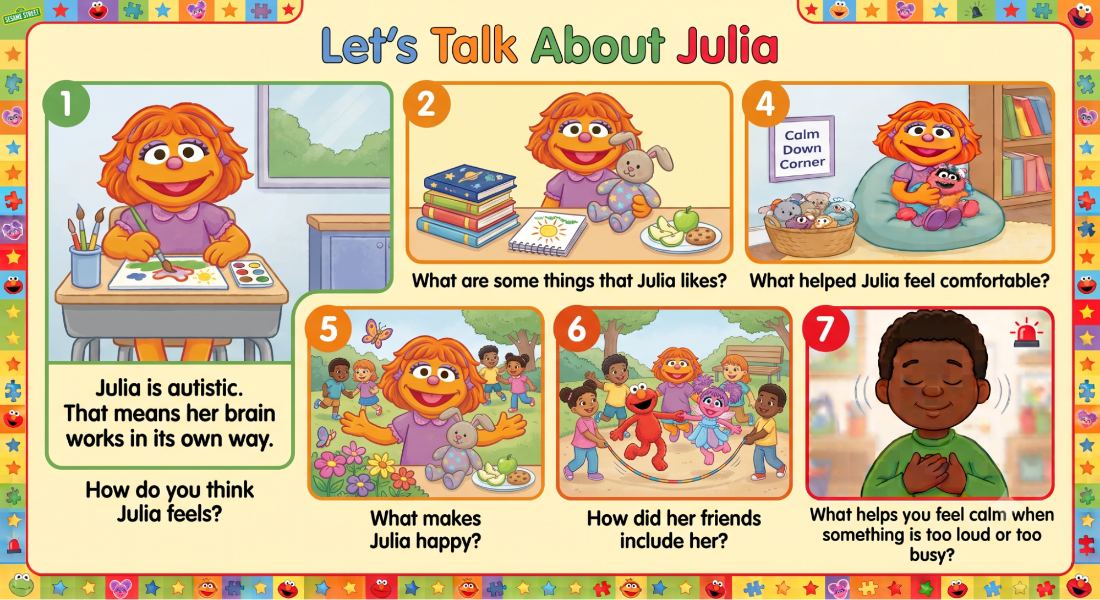
Sesame Street · Julia and See Amazing in All Children
Sesame Workshop’s Julia resources help children and adults build understanding and support. For ages 5–7, families can name autism more explicitly and talk about sensory needs and inclusive friendship.
Why it works: Julia can be a gentle bridge into the idea of autism: your autism may look like Julia’s in some ways and different in other ways.
Parent talking prompts
- Julia is autistic. That means her brain works in its own way.
- You are autistic too.
- What is something Julia likes?
- What is something that helps Julia?
- How are you and Julia the same? How are you different?
Activity idea: What helps me, what helps you
Make a two-column chart and compare supports.
- Quiet
- Headphones
- A hug
- Space
- A plan
- A favorite toy
- A quiet place
Sometimes your brain may need pictures, stories, or extra time to understand what is happening. That is okay. We can find tools that help.
Julia at Sesame WorkshopWatch a Julia video
Pablo
Follows an autistic child who uses drawing and imagination to work through everyday situations. Useful after a child knows they are autistic, because it shows an autistic character navigating ordinary life.
Why it works: Helps children recognize that autistic kids may use creativity, routines, scripts, drawings, or special interests to understand the world.
Parent talking prompts
- What was hard for Pablo?
- What helped Pablo understand the situation?
- How did drawing help him?
- What helps you when something feels confusing?
- Do different people need different ways to solve a problem?
Activity idea: Draw the problem, draw the help
Fold a paper in half. Draw a hard situation on one side and what could help on the other.
- Too loud
- A change in plans
- A new place
- A hard goodbye
- Waiting
- Someone not understanding
- A break
- Headphones
- A quiet place
Sometimes your brain may need pictures, stories, or extra time to understand what is happening. That is okay. We can find tools that help.
Pablo on YouTube
Carl the Collector · PBS Kids
Carl, an autistic raccoon, centers friendship, collections, routines, and problem-solving. A nice fit for children this age because many already understand collecting, sorting, and strong interests.
Parent talking prompts
- Carl really loves collecting.
- What is something you love learning about?
- How can we listen when someone tells us about something important to them?
- What can we do if a friend wants to talk about their favorite thing?
- How can friends take turns sharing interests?
Activity idea: Collection conversation
Invite the child to make a small collection, then practice listening and taking turns.
- Tell me about your collection
- What do you like about it?
- Can I ask a question?
- Now I’ll tell you about something I like
- Let’s take turns
Strong interests can be part of how someone learns and connects. Friends can listen, ask questions, and also take turns.
Watch on PBS Kids
Amazing Things Happen
A direct autism explainer. Use carefully with this age group. It may help a 7-year-old who is asking what autistic means, or a child who likes factual explanations. Watch together and pause often.
Why it works: Gives a broader explanation of autism than a storybook can, while still leaving room for “true for me / not true for me.”
Parent talking prompts
- What did the video say autism can affect?
- What parts sounded like you?
- What parts did not sound like you?
- What are some things that help autistic people?
- What does acceptance mean?
Activity idea: True for me / not true for me
After watching, make two piles or columns and sort examples together.
- I like routines
- Loud sounds bother me
- I notice details
- I like talking a lot
- I need breaks
- I like deep pressure
- I have strong interests
- Changes are hard
Autistic people are not all the same. Some things in the video may fit you, and some may not. We are learning what autism means for you.
Watch the videoAmazing Things Project