JavaScript is not required: every approved resource is listed below with its prompts, activity, and links.
Books & workbooks
Can You See Me? · Libby Scott & Rebecca Westcott
Tally is an autistic girl starting sixth grade and figuring out friendships, school, sensory challenges, and the pressure to fit in. Diary entries inspired by coauthor Libby Scott’s experiences show what it can feel like to be misunderstood and why being accepted matters.
Why it works: A strong choice for kids who are starting middle school or becoming more aware of fitting in socially. It opens a conversation about masking, when someone hides discomfort, interests, stims, confusion, or support needs because they do not want to stand out or be judged.
Parent talking prompts
- What parts of school felt hard for Tally?
- Why do you think Tally felt pressure to hide parts of herself?
- What does it mean to be seen by other people?
- Have you ever felt like you had to act differently to fit in?
- What would have helped Tally feel safer being herself?
- What do you wish classmates or teachers understood better?
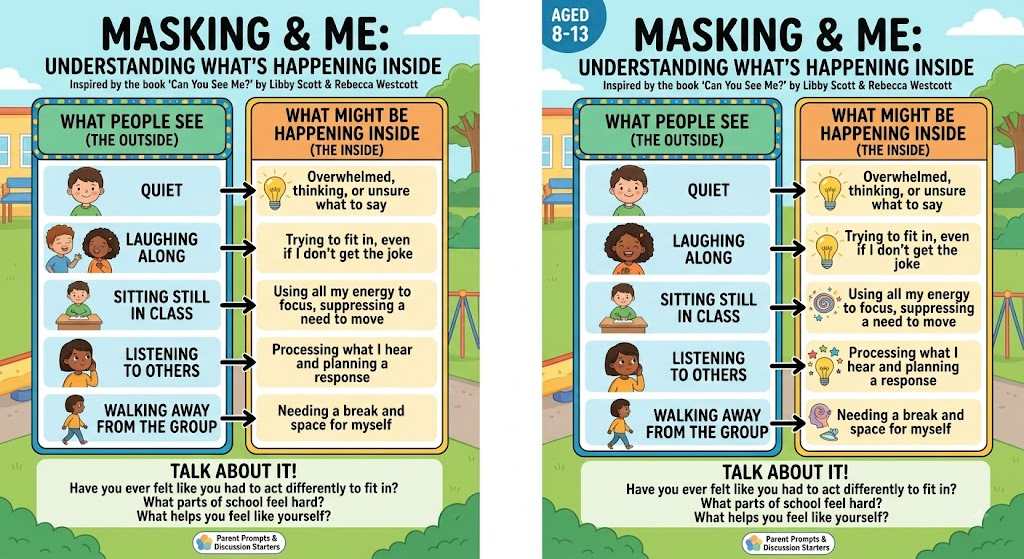
Activity idea: Masking and Me
Make two columns: what people see, and what might be happening inside.
- Quiet → overwhelmed, thinking, or unsure what to say
- Laughing along → trying to fit in
- Walking away → needing a break
- Asking many questions → trying to understand
- Repeating a topic → sharing something important
Invite the child to add examples. Sometimes people only see the outside. A child should not have to hide important parts of themselves to be accepted.
Book
A Kind of Spark · Elle McNicoll
Addie is an autistic girl in Scotland who learns about women from her town’s history who were mistreated for being different. She campaigns for a memorial in their honor while navigating what it feels like to be misunderstood.
Why it works: The story moves beyond kindness into fairness, exclusion, and what happens when people are treated differently because of a disability. It helps tweens examine how a school or community can make room for people who do not fit others’ expectations.
Parent talking prompts
- What made Addie feel misunderstood?
- What did adults or classmates get wrong about her?
- Why was the memorial so important to Addie?
- What does it mean to stand up for people who have been treated unfairly?
- Does fair always mean everyone gets the exact same thing?
- What do you think makes someone feel like they belong?
- What would a more accepting school or community look like?
- If you saw someone being left out or treated unfairly, what could you do?
- What helps you feel understood by other people?
- When do you feel comfortable speaking up for yourself, and when might you want help from an adult?
- What is something about the way your brain works that you like or that feels important to you?
Activity idea: Belonging Map
Draw three circles and add the places, people, and supports that fit each one.
- Places I feel like I belong
- Places I feel unsure or misunderstood
- Things that help me feel included
- Quiet lunch options
- A teacher who listens
- Friends who share interests
- Knowing the plan
- Movement and group-role choices
Belonging is not only being allowed into a space. It means people make room for who you actually are.
BookWatch the series
Speak Up! · Rebecca Burgess
Mia is an autistic middle schooler who is secretly a popular online musician. She balances school, friendship, and her hidden music life while other people focus on her differences instead of seeing who she really is. The book is written and illustrated by an autistic creator.
Why it works: The visual storytelling can make emotions easier to follow. It opens conversations about privacy, bullying, being seen as more than a label, and finding a form of self-expression that feels true.
Parent talking prompts
- How did other people define Mia?
- What did Mia want people to understand about her?
- Why might someone hide a talent, interest, or part of themselves?
- What does it mean to speak up in your own way?
- What are safe ways to ask for help if someone is being unkind?
- When do you feel most like yourself?
- What makes someone a good friend to you?
- How can you tell when someone respects your boundaries?
- What helps when school feels loud, busy, confusing, or uncomfortable?
- How could you let someone know when you need a break?
- How can friends support each other when they need different things?
- What do you wish people asked you instead of assuming?
- What are some ways people can communicate besides talking?
Activity idea: My Voice, My Way
Choose one way to express something important.
- Write a short note
- Make a playlist
- Draw a comic panel
- Record a voice memo
- Create a character
- Make a collage
- Choose three words that describe you
- Build something that represents you
Ask, “What do you want people to understand about you?” Speaking up can happen through words, art, music, movement, writing, technology, or a trusted adult.
Book
The Awesome Autistic Go-To Guide · Yenn Purkis & Tanya Masterman
This interactive handbook helps autistic tweens and teens understand what being autistic can look and feel like in everyday life. It covers challenges, strengths, interests, support needs, and identity.
Why it works: It speaks directly to autistic tweens and gives them room to decide which ideas fit their own experience. Seeing familiar experiences discussed openly can also feel reassuring.
Parent talking prompts
- What parts of this feel true for you?
- What parts do not fit your experience?
- What are some things your brain does really well?
- What are some things that take extra energy?
- What support would make daily life easier?
- What do you want adults to stop misunderstanding?
Activity idea: My Autistic Owner’s Manual
Create a one-page manual. The child can keep it private or share selected parts with trusted adults.
- My strengths
- My sensory needs
- My communication style
- Things that drain my energy
- Things that help me recharge
- What I wish teachers knew
- What I wish friends knew
- How to help me when I am overwhelmed
Autism does not look the same for everyone. Learn what autism means for this child instead of fitting them into someone else’s description.
Book
Just Ask! Be Different, Be Brave, Be You · Sonia Sotomayor
This picture book introduces different strengths, abilities, and challenges. It can help younger tweens, siblings, and mixed-age groups start a deeper conversation about curiosity, privacy, boundaries, and respectful questions.
Why it works: Older children can examine the difference between respectful curiosity and questions that pressure or embarrass someone. They can also practice including people without asking them to explain private information.
Parent talking prompts
- What kinds of differences did the book include?
- What makes a question respectful?
- When is it better to ask a parent privately instead of asking a person directly?
- What if someone does not want to answer?
- How can we include someone without making them explain themselves?
Activity idea: Respectful Question Sort
Sort questions into three categories.
- Okay to ask directly: “Do you want help?”
- Okay to ask directly: “Do you want space?”
- Okay to ask directly: “How would you like to play?”
- Better to ask privately: questions about another person’s speech, device, or headphones
- Not respectful: “What is wrong with you?”
- Not respectful: “Why are you so weird?”
- Not respectful: asking to touch someone’s body or device
Curiosity is okay, but people deserve privacy and respect. Questions should not embarrass or pressure someone.
Book
Slug Days · Sara Leach
An illustrated novel about the ups and downs of everyday life for an autistic girl at school and at home. It can suit younger tweens moving from picture books into longer chapter books.
Why it works: The idea of good days and hard days gives kids a simple way to discuss feelings without treating a difficult day as a failure. A hard day can signal that the brain and body need more support.
Parent talking prompts
- What makes a day feel hard?
- What makes a day feel easier?
- What does your body do when a day is becoming too much?
- What helps you before things get too hard?
- How can adults notice earlier?
Activity idea: My Weather Report
Create a daily or weekly weather report for feelings and energy.
- Sunny: I feel ready
- Cloudy: I need help starting
- Windy: my body feels restless
- Stormy: everything feels too much
- Foggy: I need fewer words
- Rainbow: something helped
Hard days do not mean a child is doing something wrong. They can tell us that the child’s brain and body need more support.
Book
Videos & learning resources
Loop
Two kids at canoe camp need to find a new way to connect. The short features Pixar’s first nonspeaking autistic character and shows communication through sensory cues, movement, choices, and patience.
Why it works: Tweens can examine perspective-taking, frustration, assumptions, consent, and the many ways people communicate. The deeper lesson is not to assume someone has nothing to say because they communicate differently.
Parent talking prompts
- What did Marcus assume at first?
- How did Renee communicate?
- What changed when Marcus stopped trying to control the situation?
- What does it mean to listen without forcing someone to communicate your way?
- What are respectful ways to connect with someone who communicates differently?
- What should we do when we feel frustrated but still want to be kind?
Activity idea: Communication Beyond Words
Choose a simple message and communicate it five different ways.
- Messages: I need a break, I want to choose, or I do not like that
- Gesture
- Drawing
- Pointing
- Facial expression
- Written words
- AAC or picture cards
- Body movement
- Choosing from options
Speech is not the same as communication. Respectful friends learn to listen in more than one way.
Watch on Disney+Pixar overview
Amazing Things Happen
A short, direct introduction to autism for autistic tweens, siblings, classmates, and friends. It connects autism to sensory overload, communication differences, strong interests, routines, and different ways of understanding the world.
Why it works: The video gives everyone a shared starting point. It can make it easier to discuss what autism looks and feels like for different people without treating one explanation as true for everyone.
Parent talking prompts
- What did the video say autism can affect?
- What are some things autistic people might experience differently?
- What parts sounded familiar?
- What parts did not?
- What stereotypes or wrong ideas do people sometimes have about autism?
- What does acceptance look like in real life?
Activity idea: Autism Myth / Autism Truth
Create cards and sort them into two piles.
- Autistic people are all the same → Myth
- Autistic people may communicate in different ways → Truth
- Needing support means someone is not smart → Myth
- Sensory experiences can feel stronger for some people → Truth
- Different people need different supports → Truth
Learning about autism helps replace guesses and stereotypes with understanding. No video can explain every autistic person.
Watch
LEANS · Learning About Neurodiversity at School
LEANS helps children learn about neurodiversity and the different ways people think, learn, communicate, and experience the world. It is designed for classrooms and also works in homeschool groups, clubs, or family learning.
Why it works: The discussion-based format helps tweens think about a classroom as a community where people may learn, communicate, and participate differently.
Parent talking prompts
- What does neurodiversity mean?
- How do different people learn best?
- What makes a classroom easier or harder for different brains?
- What is the difference between equal and fair?
- What supports help people participate?
- How can a group include people without making them feel singled out?
Activity idea: Design a Brain-Friendly Classroom
Redesign a classroom, club room, sports space, or library.
- Quiet zones
- Movement options
- Visual schedules
- Clear instructions
- Flexible seating
- Written and spoken directions
- Sensory tools
- Break cards
- Partner choices
- Different ways to show learning
A good community does not expect every brain to work the same way. It asks what helps different people participate.
Open LEANS
Together for Neurodiversity / Spectrum Resources
Family-friendly resources that explain autism in a positive, age-appropriate way. The older children’s materials use identity-first language and describe autism as part of who someone is.
Why it works: The guides focus on understanding autism within the family, while making room for challenges, strengths, identity, and support needs.
Parent talking prompts
- What does it mean for autism to be part of someone’s identity?
- What are some strengths in our family?
- What are some support needs in our family?
- How can family members show respect for each other’s differences?
- What do you want family members to understand about you?
Activity idea: Family Neurodiversity Tree
Draw a family or community tree and add how different people think, communicate, rest, play, or need support.
- Likes quiet
- Loves routines
- Needs reminders
- Thinks in pictures
- Likes talking things through
- Needs movement
- Notices details
- Gets overwhelmed by noise
- Loves deep research
- Needs alone time after school
Every family has different brains, bodies, personalities, and needs. Understanding those differences helps family members care for each other.
Open the guides
Family activities & tools
Strengths and Supports Profile
Create a one-page profile with the child. It can become a foundation for school advocacy, teacher meetings, or self-advocacy practice while keeping the child in control of what stays private.
Parent talking prompts
- What are my strengths?
- What is hard for me?
- What helps me?
- What do adults misunderstand?
- What do I want friends, teachers, or coaches to know?
- What do I want to keep private for now?
Activity idea: Build the profile
Write, draw, or choose examples for each section.
- My strengths
- Things that are hard for me
- Things that help
- Things adults misunderstand
- What I want friends to know
- What I want teachers or coaches to know
- What I want to keep private for now
Belonging Audit
Rate important spaces from 1–5, then identify what makes each place feel easier or harder. The goal is to find one concrete change an adult or friend could make.
Parent talking prompts
- What helps you feel like you belong there?
- What makes it harder?
- What could one adult or friend do differently?
Activity idea: Rate your spaces
Use a 1–5 scale for each place and add a short note or drawing.
- Classroom
- Lunchroom
- Playground
- Sports team
- Afterschool program
- Family gatherings
- Friend groups
- Online spaces, if relevant
- Therapy or support settings
Change Plan
Make a four-part plan before an upcoming change. Knowing what is settled, what is still unknown, and which supports are available can make transitions feel more manageable.
Parent talking prompts
- What is changing?
- What do I already know?
- What questions do I have?
- What supports might help?
Activity idea: Plan for the transition
Choose the supports that fit this specific change.
- Visit ahead of time
- Photos of the new place
- Written schedule
- Practice the route
- Meet the teacher or coach
- Identify a safe adult
- Choose a break plan
- Bring sensory tools
- Script what to say if overwhelmed
Friendship Green Flags and Red Flags
Talk about what respectful friendship feels like. A friend does not have to understand everything perfectly, but they should listen, respect boundaries, and make room for support needs.
Parent talking prompts
- What helps a friendship feel safe?
- How can you tell when someone respects your boundaries?
- What can you do if a friend pressures you to hide a support?
Activity idea: Sort the friendship signals
Place each example under green flag or red flag.
- Green: they listen
- Green: they give space when asked
- Green: they do not make fun of supports
- Green: they let you like what you like
- Green: they apologize
- Green: they include you without forcing you
- Green: they respect no
- Red: they tease you for stimming, interests, speech, or movement
- Red: they pressure you to hide supports
- Red: they only include you when you act a certain way
- Red: they share private information without permission
- Red: they ignore no
- Red: they say accommodations are unfair
Self-Advocacy Practice
Practice short scripts a child can use in real situations. These can be spoken, written, drawn, added to AAC, practiced with gestures, or shared through a trusted adult.
Parent talking prompts
- Which message would help in a hard moment?
- How would you like to communicate it?
- Who is a trusted adult who could help explain it?
Activity idea: Practice communication scripts
Choose one or two scripts and practice them in the child’s preferred form.
- I need a break.
- Can you say that another way?
- Please don’t touch me.
- I need more time.
- That sound hurts.
- I want to join, but I do not know how.
- I do not want to talk about that.
- I need help explaining this.
Autism & Neurodiversity Word Bank
Plain-language definitions can help tweens understand identity, explain support needs, and describe how their minds and bodies work. Children can decide which words feel useful to them.
Parent talking prompts
- Which words feel familiar?
- Which definition helps explain something important about you?
- Is there a word you would like an adult or friend to understand better?
Activity idea: Kid-friendly definitions
Read one definition at a time and connect it to a real example.
- Neurodiversity: all brains work differently, and those differences deserve respect.
- Stimming: movements or sounds that can help regulate sensory input and emotions.
- Masking: hiding stims or support needs to fit into neurotypical expectations.
- Accommodations: adjustments or tools that allow equal participation.
- Equity: giving each person what they need to participate and feel safe.
- Self-advocacy: expressing needs, preferences, or boundaries to get support.