JavaScript is not required: every approved resource is listed below with its prompts, activity, and links.
Books & storybooks
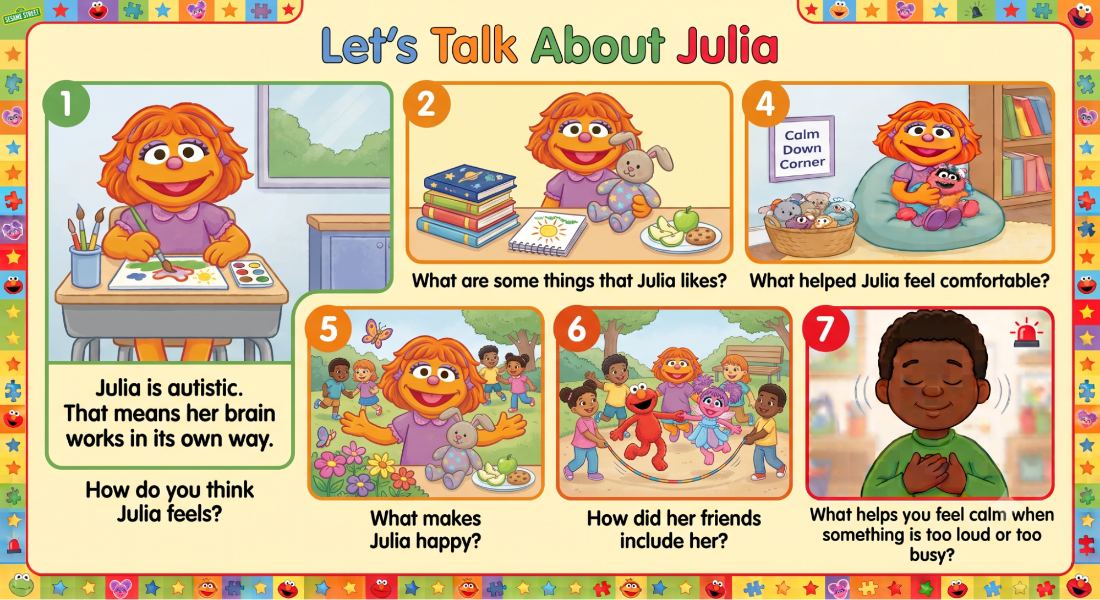
Sesame Street and Autism: Julia resources
Sesame Workshop offers free autism resources featuring Julia, a 4-year-old autistic Muppet, a bilingual collection for families, providers, and teachers, from toddlers through kindergarten.
Why it works: Julia is presented as a full child, she plays, has friends, has preferences, and sometimes needs support. Children understand autism through everyday experiences rather than abstract explanation.
Parent talking prompts
- Julia is autistic. That means her brain works in its own way.
- What helped Julia feel comfortable?
- What are some things Julia likes?
- How did her friends include her?
- What helps you feel calm when something is too loud or too busy?
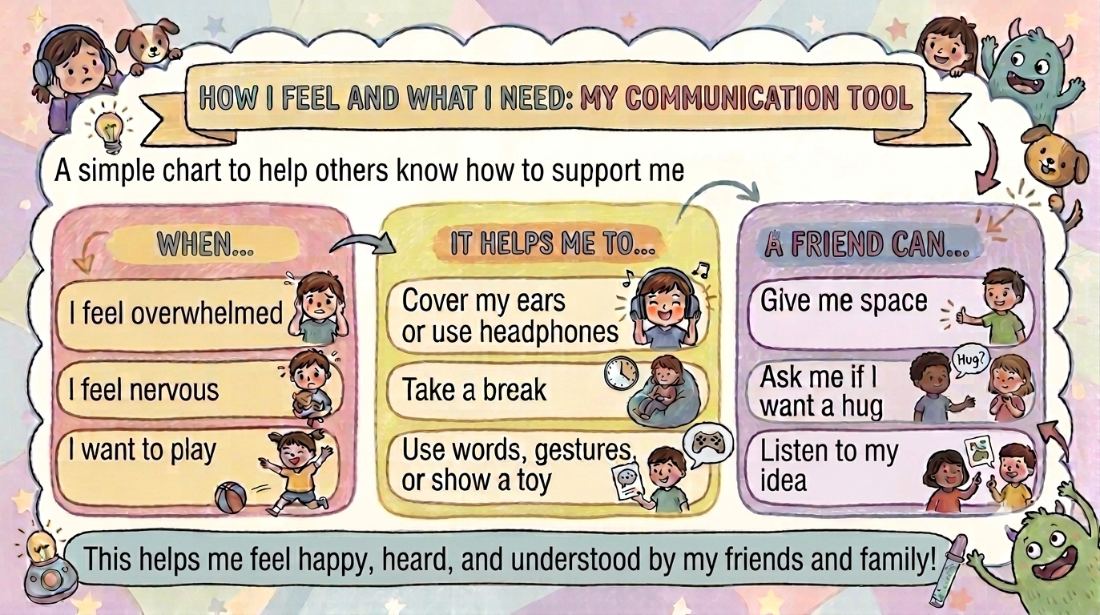
Activity idea: “What Helps Me?” chart
Make a simple family chart with three columns, When I feel… / It helps me to… / A friend can…
- Nervous about loud sounds → headphones → give me space
- I feel nervous → hold a favorite toy → wait quietly
- I want to play → use words, gestures, or show a toy → notice my idea
This helps children learn that everyone has needs, not just autistic children.
Julia at Sesame Workshop
We're Amazing 1, 2, 3! · Sesame Street
A featured autism-friendly storybook for ages 1–6, designed to help children celebrate similarities and differences.
Parent talking prompts
- What do Elmo and Julia both like?
- What is something that makes Julia different?
- What is something that makes you different from your friends?
- How can friends play together even when they do not play the exact same way?
Activity idea: Same and different sorting game
Use blocks, socks, toy animals, or family photos. Sort by “same” and “different” features. Then say:
- “People can be the same in some ways and different in some ways. Both are okay.”
BookRead-aloud video
A Friend for Henry · Jenn Bailey
Told from the perspective of Henry, a boy on the autism spectrum looking for a friend, the “everyday magic of friendship,” including Henry's preference for order and moments when things feel too close or too loud.
Why it works: It shows friendship from the autistic child's perspective, many books about autism are told from the sibling or peer's point of view.
Parent talking prompts
- Henry wanted a friend who would listen and share.
- Some things felt too loud or too close for Henry.
- What could a friend do if someone needs more space?
- What are different ways people show they want to play?
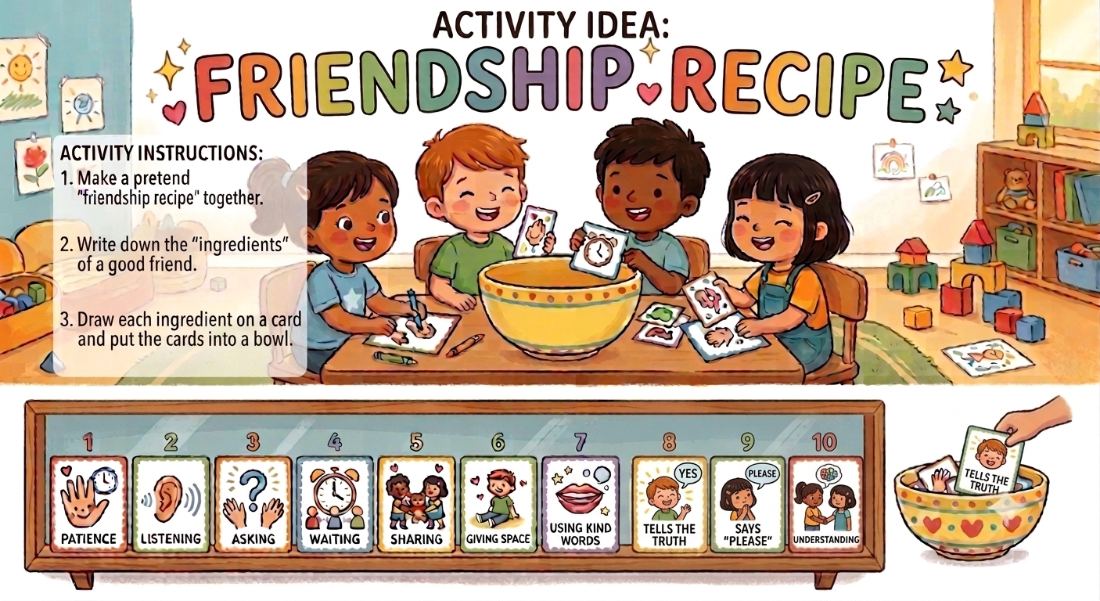
Activity idea: Friendship recipe
Make a pretend “friendship recipe” together. Draw each ingredient on a card and put the cards into a bowl:
- Patience
- Listening
- Asking
- Waiting
- Sharing
- Giving space
- Using kind words
BookRead-aloud video
My Brother Charlie · Holly Robinson Peete, Ryan Elizabeth Peete & Denene Millner
Narrated by Callie, whose twin brother Charlie is autistic, exploring autism through love, patience, and acceptance. Also available in Spanish as Mi hermano Charlie.
Parent talking prompts
- Charlie and Callie are the same in some ways and different in some ways.
- Charlie sometimes has a hard time using words.
- What are other ways people can show what they want or feel?
- How does Charlie's family show love?
Activity idea: Many ways to communicate
Practice saying “I want to play” in different ways, then say: “Talking is one way to communicate, but it is not the only way.”
- Words
- Pointing
- Showing a toy
- Drawing
- Using a picture
- Gesture
- Facial expression
BookRead-along video
All My Stripes · Shaina Rudolph & Danielle Royer
Zane, a zebra with autism, learns to appreciate all the “stripes” that make him who he is. Best for older preschoolers or kindergarteners.
Parent talking prompts
- Zane has many stripes. Autism is one part of him, but not the only part.
- What are some of your ‘stripes’?
- What is something that feels hard for you?
- What is something wonderful about you?
Activity idea: My many stripes
Give the child a paper zebra, rainbow, heart, or star. Add “stripes” for different parts of the child:
- I like music
- I love animals
- I need quiet sometimes
- I am silly
- I am brave
- I am still learning to share
A nice way to reinforce that a diagnosis or difference is only one part of a whole person.
BookRead-aloud video
It's Okay to Be Different / Está bien ser diferente · Todd Parr
A book about being yourself and embracing what makes you stand out. Broader than autism, but a great entry point, the language is simple, concrete, and affirming.
Parent talking prompts
- What is something different about each person in our family?
- What is something that makes you you?
- Can people be different and still be friends?
- What should we do if we notice someone is different from us?
Activity idea: “It's okay to…” family book
Make a homemade book with one sentence per page, and have the child illustrate each one:
- It's okay to wear headphones
- It's okay to need help
- It's okay to talk with your hands
- It's okay to play alone sometimes
- It's okay to like the same thing a lot
- It's okay to be you
BookBilingual read-aloud
Susan Laughs · Jeanne Willis & Tony Ross
Susan swings, swims, dances, and paints through everyday activities; only at the end is it revealed that Susan uses a wheelchair. Young readers identify with Susan first as an active, happy child.
Parent talking prompts
- What did Susan like to do?
- Did you notice all the things Susan could do?
- What did we learn at the end?
- Why is it important not to make guesses about what someone can or cannot do?
Activity idea: “I can / I'm learning / I need help”
Make three columns. Have the child name things they can do, things they are learning, and things they need help with. Then say:
- “Everybody has all three. Everybody can do some things, is learning some things, and needs help with some things.”
BookRead-aloud video
Can Bears Ski? · Raymond Antrobus & Polly Dunbar
Little Bear and his dad discover that Little Bear is Deaf or hard of hearing, a heartwarming story that helps families understand what it can be like to discover a child cannot hear well.
Parent talking prompts
- Little Bear was not ignoring people. He was having trouble hearing them.
- What helped Little Bear understand?
- What can we do if someone does not answer us?
- Why should we not assume someone is being rude?
Activity idea: Communication helpers
Explore different “helpers” people may use, then say: “Tools help people do things. Lots of people use tools.”
- Headphones
- Glasses
- Hearing aids
- Picture cards
- Wheelchairs
- Walkers
- Fidgets
- Timers
BookRead-aloud video
Shows & short videos
Sesame Street · Julia
Julia is one of the strongest preschool-friendly autism representations available. Sesame Workshop's autism resources are free, in English and Spanish.
Parent talking prompts
- What did Julia like?
- What helped Julia?
- How did her friends show kindness?
Activity idea: Watch-and-talk + role-play
After a Julia video, ask the prompts, then do a “kind friend” role-play with stuffed animals.
- Do you want to play?
- Do you want help?
- Do you need space?
- Can I sit with you?
Watch a Julia videoMore Julia
Daniel Tiger's Neighborhood · Max
Max, Teacher Harriet's nephew, is an autistic character who may use noise-reducing headphones, drawing, routines, and support with personal space.
Parent talking prompts
- Max needed a little more time.
- Max used headphones when sounds felt too loud.
- What helps you when things feel too loud or too busy?
- How can Daniel be a good friend?
Activity idea: Calm-down toolbox
Create a small box with calming options. Practice saying: “When my body feels too busy, I can choose something that helps.”
- Soft toy
- Headphones
- Picture book
- Sensory bottle
- Breathing card
- Small fidget
Watch
Carl the Collector · PBS Kids
Carl is an autistic raccoon who loves collecting things and hanging out with his friends, a sweet, easy way for kids to see that everyone thinks, plays, communicates, and reacts to the world a little differently.
Parent talking prompts
- Carl really loves collecting things.
- What is something you love learning about?
- People can have strong interests. That can be a wonderful thing.
- How do Carl's friends listen to him?
Activity idea: My collection show-and-tell
Invite the child to make a tiny collection, rocks, leaves, toy cars, stickers, buttons, and ask:
- What do you notice?
- How are they the same?
- How are they different?
- What do you want people to know about your collection?
This helps children respect strong interests rather than teasing or dismissing them.
Watch on PBS Kids
Thomas & Friends: All Engines Go · Bruno the Brake Car
Bruno is the franchise's first autistic character, voiced by an autistic child actor in the UK version. Bruno likes schedules and routines, signals his emotions, and may use headphones to muffle loud noises.
Parent talking prompts
- Bruno likes knowing what will happen next.
- What helps Bruno when things are loud?
- Do you like plans or surprises?
- What can friends do when someone feels worried?
Activity idea: Visual schedule
Make a simple picture schedule for a common routine, then say: “Some people feel better when they can see what is coming next.”
- Breakfast
- Get dressed
- Brush teeth
- Shoes
- Car / school
Watch
Donkey Hodie · Jeff Mouse
Jeff Mouse has congenital muscular dystrophy and uses a wheelchair. The character was developed with disability consultants and voiced by an actor with multiple disabilities.
Parent talking prompts
- Jeff uses a wheelchair to move around.
- People can move in different ways.
- What are different ways people can join a game?
- How can we make room for everyone?
Activity idea: Build an accessible playground
Using blocks or toys, build a playground or town where everyone can get around:
- Ramps
- Wide paths
- Quiet spaces
- Signs
- Places to rest
Meet Jeff Mouse
Xavier Riddle and the Secret Museum · “I Am Temple Grandin”
Yadina meets Temple Grandin, who is autistic, and learns that people may notice, explore, and understand the world in different ways, a concrete social idea preschoolers can use right away with siblings, classmates, and friends.
Parent talking prompts
- Temple noticed things in her own way.
- Different people can have different ideas.
- What did Yadina learn?
- How can we be kind when someone wants to do something differently?
Activity idea: “Explore It Your Way”
Give the child one simple object, a pinecone, shell, block, or leaf, and invite them to explore it in different ways. Then have another person explore it their own way.
- Look closely
- Touch it
- Sort it
- Draw it
- Build with it
- Pretend with it
- Line it up
- Tell a story about it
“We all explored the same thing in different ways. Different ways of learning and playing can all be okay.”
Watch